Crop-Livestock


From 9-10 December 2010, Researchers in a project carrying out four regional cases studies of ‘crop residue trade-offs in crop–livestock systems’ met in Addis Ababa to review progress and plans.

We recorded the reporting back sessions that discussed lessons and gaps related to the content focus of the project, the process followed so far, and the tools used.

In this video, Alan Duncan reports on the content discussions. Some ‘gaps’: Are the survey tools capturing sufficiently the higher-level policy and institutional environment? Are we capturing more open questions about how farmers make decisions? On the lessons: we need to better integrate the social with the technical; and we need to keep our eyes on the global drivers, as well as the regional ones. View the video

In this video, Diego Valbueno reports on the discussions of the process lessons and gaps. First, such a regional study needs someone to really facilitate coordination, harmonization and information sharing (among the regions and not just between regions and the central project coordination). We needed a common understanding of the tools we are using, and why. Very important – how are we going to disseminate information – to farmers, to policy? Are there some better ways in which we could have developed our framework and instruments? Perhaps we could have had a better picture of our analysis steps before we devised our data collection instruments? View the video

In this video, Nils Teufel reports on the tools and technical software used in the project, including SPSS, CSPRO, Google Earth. A big issue across the tools was training and we need to, for instance, draw on people with specialist knowledge across the project. Data management and archiving was discussed and some lessons from the questionnaires and survey tools were derived. View the video

More on the meeting

The corporate report looks ‘back to the future’—to the thousand million farmers practicing small-scale mixed crop-and-livestock agriculture in poor countries—the kind of seemingly old-fashioned family farming systems that have become so fashionable in recent years among those wanting to reform the industrial food systems of rich countries.

The report synthesizes results of a study, ‘Drivers of change in crop-livestock systems and their potential impacts on agro-ecosystem services and human well-being to 2030,’ being published in book form in 2011. The study was a collaborative endeavour conducted by a group of scientists in centres belonging to the Consultative Group on International Agricultural Research (CGIAR). The study was funded and coordinated by the CGIAR’s Systemwide Livestock Programme and led by Mario Herrero, a livestock systems analyst at the International Livestock Research Institute.

The SLP study shows that it is not big efficient farms on high potential lands but rather one billion small ‘mixed’ family farmers tending rice paddies or cultivating maize and beans while raising a few chickens and pigs, a herd of goats or a cow or two on relatively extensive rainfed lands who feed most of the world’s poor people today, and is likely to play the biggest role in global food security over the next several decades, as world population grows and peaks (at 9 billion or so) with the addition of another 3 billion people.

Read the report in pdf

Smallholders in mixed crop–livestock systems make up a large proportion of the farming enterprises in developing countries. In these systems, crop residues are an important component of production since they have multiple uses including livestock feed, construction materials, cooking fuel and organic fertilizer for the fields.

Mixed crop–livestock systems are very dynamic and are evolving rapidly in response to external drivers such as demographic pressure, development of urban markets, climate variability and climate change. In addition, recent interest in biofuels has further implications for land use and resource allocation.

This study aims to improve understanding of the tradeoffs among different crop residue uses in cereal-based systems in four regions: millet-, sorghum-, and maize-based systems in West Africa; maize-based systems in eastern Africa, maize- and sorghum-based systems in southern Africa; and wheat/rice-based systems in South Asia. The major trade-off in most systems is the short-term benefit gained from using crop residues to feed livestock versus the longer-term benefit gained from leaving crop residues in the field to improve soil fertility and control erosion.

The study focuses on decision-making processes at the farm and household level and the findings will capture the diversity and contrasts as well as recent changes in crop residue uses at various scales. The results will help decision makers to target technical, institutional and policy options to improve livelihoods, without compromising the long-term sustainability of these farming systems.

Project Flyer

Newsletter July 2010

Newsletter August 2010

Newsletter September 2010

The final report of the SLP projet Balancing livestock needs and soil conservation: assessment of opportunities in intensifying cereal–livestock systems in West Africa led by IITA in collaboration with ICRISAT and ILRI is now available on line

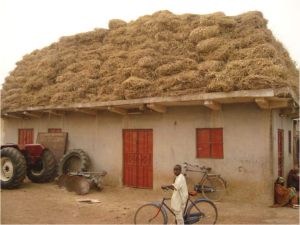
Photo: Tahirou Abdoulaye (IITA)

The general objective of the project was to identify key areas where research can make a difference in balancing trade-offs among livestock, soil, and crops, while taking advantage of synergies in evolving crop–livestock systems. The project focused on the identification of socioeconomic factors influencing decision-making on crop residue uses, quantification of trade-offs in using crop residues as soil amendment or livestock feed, and the identification of entry points for improving the productivity of cereal–legume–livestock systems.

An interesting study by Wageningen University which unfortunately ignores completely livestock in the system, crop residues playing a major as feed. System specific trade-off analyses are certainly needed to assess competitive use of crop residues to either feed animals, maintain soil productivity or produce energy looking both at short and long term impacts on livelihoods and system productivity.

see FAO website

The Consultation process will now move into the second part which is the face-to-face Workshop scheduled to be held from 23-26 March 2010 at Embrapa, Sete Lagaos, Minas Geráis, Brazil.

The Workshop programme and agenda will be posted on the above website this week, and the outcome of the Workshop will be shared with you in due course.

The Thematic Papers are part of a Toolkit for Project Design recently published by IFAD which reflects its commitment to developing a sustainable livestock sector in which poor farmers and herders might have higher incomes, and better access to assets, services, technologies and markets. They intend to be practical tools for development practitioners, project designers and policymakers to define appropriate livestock development interventions with recommendations on critical issues and also possible responses and actions to encourage the socio-economic empowerment of poor livestock keepers.

–          Emergency Livestock Interventions in Crisis and Post-crisis Situations

–          Gender and Livestock: Tools for Design

–          Integrated Crop-Livestock Farming Systems

–          Livestock and Climate Change

–          Livestock and Land

–          Livestock and Pastoralists

–          Livestock and Rural Finance

–          Value Chains, Linking Producers to the Markets

–          Water and Livestock for Rural Livelihoods

From the Food Climate Research Network

This briefing paper explores some of the arguments surrounding the relationship between what we feed and how we rear farm animals, and the availability and accessibility of food for human consumption. Does livestock production foster or hinder food security? In what ways are the contributions of intensive and extensive systems to food security different?

Link to PDF

From the Food Climate Research Network

The purpose of this briefing paper is to explore the different ways in which one might view the contributions that livestock in intensive and extensive systems make to greenhouse gas emissions. Why do people draw different conclusions about intensive versus extensive systems? How far do these conclusions reflect differing approaches to quantifying emissions, to considering land use, and to accepting future demand for animal source foods?

Link to PDF

Documents related to the consultation can be found on the FAO web site.

BriefSummary-Theme2-15-02-10Preview

« Previous PageNext Page »

Design a site like this with WordPress.com
Get started