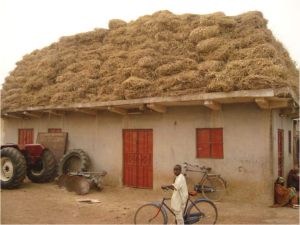
Crop Residues


This week, research teams on the SLP-supported project ‘Optimizing benefits from crop residues in smallholder crop-livestock systems in Africa and South Asia regional case studies’ are meeting in Addis Ababa to review progress and workplans. The two-year project is carrying out regional case studies in South Asia, Southern Africa, East Africa and West Africa.

The meeting was opened by Systemwide Livestock Programme (SLP) Coordinator Bruno Gerard. He introduced the project and the three principal research questions:

  • What determines the decisions about crop residue use (current crop management, agro-ecology, markets/institutions, resource endowments and dynamics)?
  • What is the impact of those decisions on livelihood and system sustainability?
  • What are the technology, institutional and policy options that would enhance livelihood and environmental benefits?

See his presentation:

He also introduced a survey of the participants to gather some information on who’s attending the meeting, their views on the project goals and approach, issues associated with crop residues, and on the SLP itself.

See the survey results online at http://tinyurl.com/slpsurvey

See the project proposal and flyer

See the meeting wiki page

See the December 2010 newsletter

Advertisement
Privacy Settings

Important components of the ‘Optimizing benefits from crop residues in smallholder crop-livestock systems in Africa and South Asia regional case studies’ project are village and household surveys in each of the four regions.

The village group surveys aim to capture: drivers and market access, communal feed resources, and systems evolution in term of feeding strategies and soil productivity. The thematic household surveys aim to capture: decision making for the allocation of crop residues, soil fertility management practices and feeding strategies, and retrospective questions to understand farm evolution and trajectories.

During is week’s project review and planning meeting, Diego Valbuena shared some comparative aggregated village data from the 7 different project sites – in Bangladesh, Ethiopia, India, Kenya and Zimbabwe.

See his presentation:

See the project proposal and flyer

See the meeting wiki page

CARWG with support from the Food and Agriculture Organization of the United Nations (FAO), The Food, Agriculture and Natural Resources Policy Analysis Network (FANRPAN), The African Conservation Tillage Network (ACT) and the African Union’s New Partnership for Africa’s Development (NEPAD) is hosting a regional symposium on Conservation Agriculture in Johannesburg South Africa, 8-9 February 2011.

The symposium has the following objectives:
1. To share and document information on the biophysical, social and economic impacts of Conservation Agriculture technologies in the region;
2. To share and document experiences on Conservation Agriculture scale up approaches and impacts; and
3. To identify key areas for research and development and explore institutional and policy innovations for Conservation Agriculture scale up.

CA_Symposium_Call_for_Papers_October_2010

Smallholders in mixed crop–livestock systems make up a large proportion of the farming enterprises in developing countries. In these systems, crop residues are an important component of production since they have multiple uses including livestock feed, construction materials, cooking fuel and organic fertilizer for the fields.

Mixed crop–livestock systems are very dynamic and are evolving rapidly in response to external drivers such as demographic pressure, development of urban markets, climate variability and climate change. In addition, recent interest in biofuels has further implications for land use and resource allocation.

This study aims to improve understanding of the tradeoffs among different crop residue uses in cereal-based systems in four regions: millet-, sorghum-, and maize-based systems in West Africa; maize-based systems in eastern Africa, maize- and sorghum-based systems in southern Africa; and wheat/rice-based systems in South Asia. The major trade-off in most systems is the short-term benefit gained from using crop residues to feed livestock versus the longer-term benefit gained from leaving crop residues in the field to improve soil fertility and control erosion.

The study focuses on decision-making processes at the farm and household level and the findings will capture the diversity and contrasts as well as recent changes in crop residue uses at various scales. The results will help decision makers to target technical, institutional and policy options to improve livelihoods, without compromising the long-term sustainability of these farming systems.

Project Flyer

Newsletter July 2010

Newsletter August 2010

Newsletter September 2010

The final report of the SLP projet Balancing livestock needs and soil conservation: assessment of opportunities in intensifying cereal–livestock systems in West Africa led by IITA in collaboration with ICRISAT and ILRI is now available on line

Photo: Tahirou Abdoulaye (IITA)

The general objective of the project was to identify key areas where research can make a difference in balancing trade-offs among livestock, soil, and crops, while taking advantage of synergies in evolving crop–livestock systems. The project focused on the identification of socioeconomic factors influencing decision-making on crop residue uses, quantification of trade-offs in using crop residues as soil amendment or livestock feed, and the identification of entry points for improving the productivity of cereal–legume–livestock systems.

An interesting study by Wageningen University which unfortunately ignores completely livestock in the system, crop residues playing a major as feed. System specific trade-off analyses are certainly needed to assess competitive use of crop residues to either feed animals, maintain soil productivity or produce energy looking both at short and long term impacts on livelihoods and system productivity.

News from from ScienceDev.Net site

Preserving biodiversity may be the goal of conservationists and environmental activists, but preserving biomass is a more important priority for the poor, says a literature review.

The finding, which researchers said was unexpected, was the result of one of three reviews presented to a symposium this week (28-29 April).

“People just don’t care about biodiversity,” Craig Leisher, of the US-based Nature Conservancy, told SciDev.Net at the meeting, ‘Linking biodiversity conservation and poverty reduction: what, why and how?’ which was held at the UK’s Zoological Society of London.

Read the full story

see FAO website

The Consultation process will now move into the second part which is the face-to-face Workshop scheduled to be held from 23-26 March 2010 at Embrapa, Sete Lagaos, Minas Geráis, Brazil.

The Workshop programme and agenda will be posted on the above website this week, and the outcome of the Workshop will be shared with you in due course.

In Science today:

‘….Although Brazilian sugar cane is the most competitive ethanol feedstock today, the United States and Europe are investing heavily in next-generation approaches. In 2009, the U.S. Department of Energy alone budgeted more than $325 million for biofuel science and demonstration plants. Much of that effort is aimed at “cellulosic ethanol,” or how to obtain fermentable sugars cheaply from straw, wood chips, and other plant material normally considered waste’

Science 327 (5968), 928. [DOI: 10.1126/science.327.5968.928]
Summary »Full Text »PDF »

Note: Next generation biofuel might have a major impact on livestock feeding, new opportunities for feeding monograstics and could be a treat to sustainability in some production systems. It will create  new competitive interests for cereal crop residues (conservation agriculture practitioners strongly advocating for keeping large amounts of residues in the field to maintain or improve long term productivity)

From the Food Climate Research Network

This briefing paper explores some of the arguments surrounding the relationship between what we feed and how we rear farm animals, and the availability and accessibility of food for human consumption. Does livestock production foster or hinder food security? In what ways are the contributions of intensive and extensive systems to food security different?

Link to PDF

« Previous PageNext Page »