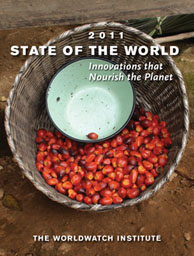
The 2011 State of the World edition from Worldwatch was released yesterday.  It is reported to give a compelling look at the global food crisis, with particular emphasis on global innovations that can help solve a worldwide problem.

Read more

The pdf version costs $19.95! Why isn’t that document a free public good?

This week, research teams on the SLP-supported project ‘Optimizing benefits from crop residues in smallholder crop-livestock systems in Africa and South Asia regional case studies’ are meeting in Addis Ababa to review progress and workplans. The two-year project is carrying out regional case studies in South Asia, Southern Africa, East Africa and West Africa.

The meeting was opened by Systemwide Livestock Programme (SLP) Coordinator Bruno Gerard. He introduced the project and the three principal research questions:

  • What determines the decisions about crop residue use (current crop management, agro-ecology, markets/institutions, resource endowments and dynamics)?
  • What is the impact of those decisions on livelihood and system sustainability?
  • What are the technology, institutional and policy options that would enhance livelihood and environmental benefits?

See his presentation:

He also introduced a survey of the participants to gather some information on who’s attending the meeting, their views on the project goals and approach, issues associated with crop residues, and on the SLP itself.

See the survey results online at http://tinyurl.com/slpsurvey

See the project proposal and flyer

See the meeting wiki page

See the December 2010 newsletter

Important components of the ‘Optimizing benefits from crop residues in smallholder crop-livestock systems in Africa and South Asia regional case studies’ project are village and household surveys in each of the four regions.

The village group surveys aim to capture: drivers and market access, communal feed resources, and systems evolution in term of feeding strategies and soil productivity. The thematic household surveys aim to capture: decision making for the allocation of crop residues, soil fertility management practices and feeding strategies, and retrospective questions to understand farm evolution and trajectories.

During is week’s project review and planning meeting, Diego Valbuena shared some comparative aggregated village data from the 7 different project sites – in Bangladesh, Ethiopia, India, Kenya and Zimbabwe.

See his presentation:

See the project proposal and flyer

See the meeting wiki page

CARWG with support from the Food and Agriculture Organization of the United Nations (FAO), The Food, Agriculture and Natural Resources Policy Analysis Network (FANRPAN), The African Conservation Tillage Network (ACT) and the African Union’s New Partnership for Africa’s Development (NEPAD) is hosting a regional symposium on Conservation Agriculture in Johannesburg South Africa, 8-9 February 2011.

The symposium has the following objectives:
1. To share and document information on the biophysical, social and economic impacts of Conservation Agriculture technologies in the region;
2. To share and document experiences on Conservation Agriculture scale up approaches and impacts; and
3. To identify key areas for research and development and explore institutional and policy innovations for Conservation Agriculture scale up.

CA_Symposium_Call_for_Papers_October_2010

Smallholders in mixed crop–livestock systems make up a large proportion of the farming enterprises in developing countries. In these systems, crop residues are an important component of production since they have multiple uses including livestock feed, construction materials, cooking fuel and organic fertilizer for the fields.

Mixed crop–livestock systems are very dynamic and are evolving rapidly in response to external drivers such as demographic pressure, development of urban markets, climate variability and climate change. In addition, recent interest in biofuels has further implications for land use and resource allocation.

This study aims to improve understanding of the tradeoffs among different crop residue uses in cereal-based systems in four regions: millet-, sorghum-, and maize-based systems in West Africa; maize-based systems in eastern Africa, maize- and sorghum-based systems in southern Africa; and wheat/rice-based systems in South Asia. The major trade-off in most systems is the short-term benefit gained from using crop residues to feed livestock versus the longer-term benefit gained from leaving crop residues in the field to improve soil fertility and control erosion.

The study focuses on decision-making processes at the farm and household level and the findings will capture the diversity and contrasts as well as recent changes in crop residue uses at various scales. The results will help decision makers to target technical, institutional and policy options to improve livelihoods, without compromising the long-term sustainability of these farming systems.

Project Flyer

Newsletter July 2010

Newsletter August 2010

Newsletter September 2010
Brazil has revolutionised its own farms. Can it do the same for others?

An interesting article in the Economist on the transformation of farming systems in the cerrado of Brazil. Certainly addressing food security at global level but may be not equity, the future of small scale enterprises and other social and environmental issues…  To put in parallel with technical models linked to land deals (grabs) in Africa?

A related story: the recent and ambitious development partnership plan aiming at strengthening agricultural collaboration between Africa and Brazil which was launched at the 5th FARA/ African Agriculture Science Week in Burkina Faso on 21 July.

From Science Blog 26/08/10

Cattle grazing maize residues after harvest in Zimbabwe. Photo: Sabine Homann

As climate change intensifies drought conditions in Africa and sparks fears of a new cycle of crippling food shortages, a study released today finds widespread adoption of recently developed drought-tolerant varieties of maize could boost harvests in 13 African countries by 10 to 34 percent and generate up to US$1.5 billion in benefits for producers and consumers.

Read the full story

SLP Comments: Benefits of drought tolerant maize by-products/crop residues should also be addressed as the technology is mainly targeting mixed crop-livestock smallholders

by Place F, Roothaert R, Maina L, Franzel S, Sinja J and Wanjiku J.

Abstract
The objective of this study is twofold, to demonstrate (1) the effects of fodder shrubs on milk production and their value at the household and regional level and (2) the contribution of research by the World Agroforestry Centre toward strengthening the impact of fodder shrubs. The study is a synthesis of previous studies related to dissemination, adoption and impact combined with two new analyses, one quantitatively measuring the impact of the shrubs through econometric analysis and the other a qualitative analysis to better understand constraints on adoption and gender issues related to participation and control of benefits from fodder shrubs. Among the study findings are that fodder shrubs have been widely adopted in East Africa, by an estimated 205,000 smallholder dairy farmers by 2005. Women were active in planting shrubs, as monitoring found almost half of planters to be women. Several studies have confirmed that shrubs do have an impact on milk production. While feeding trials have found that 1 kilogram of calliandra increases milk production by 0.6–0.8 kilograms, a new survey of farmers’ perceptions in Kenya found the effect to be about half as large after controlling for the effects of breeds, season and other feeds. Whether the effect is the lower or higher estimate, the overall impact of theshrubs in terms of additional net income from milk is high, at US$19.7 million to $29.6 million in Kenya alone over the past 15 years.

Full report in pdf

The ‘Centre International de Recherche‐Développement sur l’Elevage en Zone Subhumide (CIRDES)’ is seeking:

A Director General

A Scientific Director

The Grains Research and Development Corporation (GRDC) and the Australian Centre for International Agricultural Research (ACIAR) will support the 5th WCCA and 3rd FSD be held in Australia in September 2011.

The combination of 5th WCCA and 3rd FSD effort brings a unique opportunity to discuss the application of conservation agriculture principles from a farming systems perspective. At this meeting we will discuss conservation agriculture principles in both large-scale, high-tech commercial farms, and small-scale low-cost smallholder farms from developing regions in the world in the context of food security concerns, increasing food demand and climate change.

The Congress expects to attract over 700 scientists, students, farm managers, policy makers, conservationists and others interested in sustainability, conservation and farming systems.

For more info

Design a site like this with WordPress.com
Get started