An interesting letter exchange between John McDermott (ILRI’s Deputy Director General for Research) and Vicki Hird (Senior Food Campaigner at Friends of the Earth) is published in the June 2010 issue of People&Science
Climate Change
Archived Posts from this Category
June 10, 2010
Meat, food security, climate change… Should we eat less meat to increase food security?
Posted by brugerard under Climate Change, Food security, NewsLeave a Comment
May 5, 2010
World scientists meet again over climate change in Kenya
Posted by brugerard under Climate Change, Food security, Meetings, NewsLeave a Comment
Read on People Daily Online website (China)
Climate change in Africa and the world at large has impacted on many fronts resulting in drought and floods hence resulting in food shortage.
Consequently, poverty levels have increased leading to low development among many developing nations.
It is against this backdrop that leading agriculture and climate scientists, policymakers, farmers, and development experts from around the world will gather in Nairobi from today to focus on the threat of climate change to the global food supply.
The conference is jointly convened by the Consultative Group on International Agricultural Research (CGIAR) and the Earth System Science Partnership (ESSP).
Speakers are drawn from World Agro forestry Centre (ICRAF), International Livestock Research Institute (ILRI), UNEP, and the Intergovernmental Panel on Climate Change (IPCC).
The conference conveners noted that if climate change is not checked, it could negatively affect efforts to reduce poverty and hunger.
This would threaten the stability of entire nations as farmers struggle in hotter and more uncertain conditions to feed a population set to reach 9 billion people by 2050. Less rain and changing rainfall patterns have resulted in low yields.
According to the Food and Agricultural Organization (FAO) of the United Nations, one in three people living in Sub-Saharan Africa were chronically hungry in 2007.
The region is also hardest hit by extreme poverty, harboring 75 percent of people worldwide that live on less then a dollar a day.
Since 2007, erratic rainfall has led to increased food shortages in southern Africa where droughts damaged and destroyed maize crops.
A study by the International Food Policy Research Institute (IFPRI) warns that in Africa alone, over the next four decades higher temperatures and more frequent droughts could depress wheat yields by over 30 percent, rice by 15 percent, and maize by 10 percent.
Yet FAO has projected that over this same period food production globally must increase by 70 percent to feed a population expected to reach 9.1 billion people.
IFPRI found that neutralizing the effects of climate change on productivity requires investing at least 7 billion dollars per year on research, irrigation, and rural roads.
The conference comes in the wake of talks in Copenhagen last December, where high-level recognition of the link between climate change and food security was reinforced.
In a month’s time, climate change negotiators reconvene in Bonn, Germany to continue discussions to reach consensus on a new global agreement for reducing greenhouse gas emissions and adapting to their impacts.
African leaders have been particularly frustrated by the failure of negotiators to give adequate attention to the food security-climate change connection and have joined other developing country officials in declaring: “no agriculture, no agreement.”
Scientists blame climate change for causing more intense and frequent droughts, floods, hurricanes, rising sea levels, and other negative effects in different parts of the world.
The cheapest and most efficient way to mitigate the harmful effects of climate change on poor nations like Kenya is to have lots of trees. Trees absorb excess carbon dioxide and other harmful gases from the atmosphere. But when trees are cut down, this process is halted.
The government recently, launched the third phase of tree planting in bid to reclaim Kenya’s water tower the Mau forest and forest cover.
Source:Xinhua
April 16, 2010
Extreme Weather Tests Pastoralist Perceptions in Kenya
Posted by brugerard under Climate Change, News, PastoralismLeave a Comment
The effects of climate change – such as drought, livestock deaths and resource conflict – may be all too apparent for the pastoralists of northern Kenya, but there is much to be done to explain the true causes
Read the rest of the story on allAfrica.com
March 8, 2010
Zambia – Difficult time in the farm sector
Posted by brugerard under Climate Change, News, South AsiaLeave a Comment
From the Meat Trade News Daily website
New evidence from a study from the International Food Policy Research Institute (IFPRI) indicates that on-going extreme changes and variability in Zambia’s climate could bring losses of more than US$4 billion in agricultural income in the next 10 years, driving hundreds of thousands into poverty and food insecurity.
February 16, 2010
Intensive versus extensive livestock systems and greenhouse gas emissions
Posted by brugerard under Climate Change, Crop-Livestock, Global, Intensification, PublicationLeave a Comment
From the Food Climate Research Network
The purpose of this briefing paper is to explore the different ways in which one might view the contributions that livestock in intensive and extensive systems make to greenhouse gas emissions. Why do people draw different conclusions about intensive versus extensive systems? How far do these conclusions reflect differing approaches to quantifying emissions, to considering land use, and to accepting future demand for animal source foods?
February 12, 2010
ILRI-led, SLP-funded study published today in Science Special Issue on Food Security
Posted by brugerard under Climate Change, Crop-Livestock, Food security, Global, Intensification, News1 Comment
Smart Investments in Sustainable Food Production: Revisiting Mixed Crop-Livestock Systems
M. Herrero P. K. Thornton, A. M. Notenbaert, S. Wood, S. Msangi, H. A. Freeman, D. Bossio, J. Dixon, M. Peters, J. van de Steeg, J. Lynam, P. Parthasarathy Rao, S. Macmillan, B. Gerard, J. McDermott, C. Seré, M. Rosegrant
Farmers in mixed crop-livestock systems produce about half of the world’s food. In small holdings around the world, livestock are reared mostly on grass, browse, and nonfood biomass from maize, millet, rice, and sorghum crops and in their turn supply manure and traction for future crops. Animals act as insurance against hard times and supply farmers with a source of regular income from sales of milk, eggs, and other products. Thus, faced with population growth and climate change, small-holder farmers should be the first target for policies to intensify production by carefully managed inputs of fertilizer, water, and feed to minimize waste and environmental impact, supported by improved access to markets, new varieties, and technologies.
January 25, 2010
Challenge Program for Climate Change, Agriculture and Food Security (CCAFS) is looking for Regional Facilitators
Posted by brugerard under Climate Change, Job opportunityLeave a Comment
CCAFS is seeking Regional Facilitators for West Africa, Eastern Africa and the Indo-Gangetic Plains. The Regional Facilitators will be hosted by CGIAR centres operating in the regions, and will be employed through the host Centre
Locations: Niamey, Niger; Nairobi, Kenya; Delhi, India
Ideal candidates should have the following attributes:
- At least 5 years relevant experience in the agricultural systems of the region; preferably with a PhD.
- Experience in dealing with multiple stakeholders within the region, from local to regional level.
- Evidence of the ability to foster outcomes and impacts from research
- Experience in fostering teamwork and collaborative cross-disciplinary approaches using facilitation techniques
- Experience, and credible scientific outputs, in any of the topics that CCAFS deals with
- Experience with managing budgets and people
- Evidence of fund-raising at regional level
- Fluency in English (and French for West Africa) is required; proficiency in one of regional languages is desirable
Deadline: February 20, 2010
January 21, 2010
New book ‘Science and Innovation for Development’
Posted by brugerard under Climate Change, Crop-Livestock, DFID, Food security, Innovation Systems, PublicationLeave a Comment
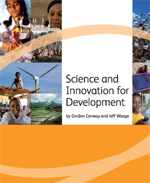 Science and Innovation for Development

By Professor Sir Gordon Conway and Professor Jeff Waage, with Sara Delaney. Published by UKCDS January 2010.
ISBN: 978 1 84129 0829
‘…We hope that this book will give anyone who is interested in international development a clearer picture of the role that science and innovation can play. We firmly believe that science is only one of many factors which can contribute to development, but we want that factor to be well understood, particularly as science is often presented in a way which is not easily accessible to the non-specialist. We have used the MDGs as a framework for our exploration, because they address a wide range of development issues where science is particularly active: agriculture, health, and the environment….’ Gordon Conway, Jeff Waage and Sara Delaney
Hard copies will be provided free of charge to researchers and policy-makers in developing countries (see above link).
January 16, 2010
The International Organization for Animal Health has announced that it plans to study the impact of livestock and poultry production on climate change
Posted by brugerard under Climate Change, Food security, News1 Comment
The International Organization for Animal Health (OIE) has announced that it plans to study the impact of livestock and poultry production on climate change, its first foray into environmental issues.
OIE director-general Bernard Vallat noted that there are interests that have suggested that eating fewer animal products would benefit the environment but said the issue should not be oversimplified. “It’s a question that needs to be studied with a lot of distance,” he said.
Vallat said it must be recognized that livestock and poultry production provides the world with meat, milk and eggs and should not be cut back at a time when the world’s growing population demands and needs more protein.
Source: Feedstuff
January 14, 2010
Grasslands To Combat Climate Change
Posted by brugerard under Climate Change, Food security, News, Pastoralism1 Comment
From Voice of America
A new report from the United Nations Food and Agriculture Organization says grasslands have vast untapped potential to limit climate change by absorbing and storing carbon dioxide. The report says proper land use can also help one billion people who depend on livestock.


The United Nations report says if pastures and rangelands are properly managed, they can be a useful carbon sink – potentially more powerful than forests in the battle against climate change. The report says that agricultural lands can help control global warming by limiting greenhouse gas emissions. At the same time, the report also states that these kinds of agriculture practices can increase land productivity which will lead to stronger food security.


 Systemwide Livestock Programme